


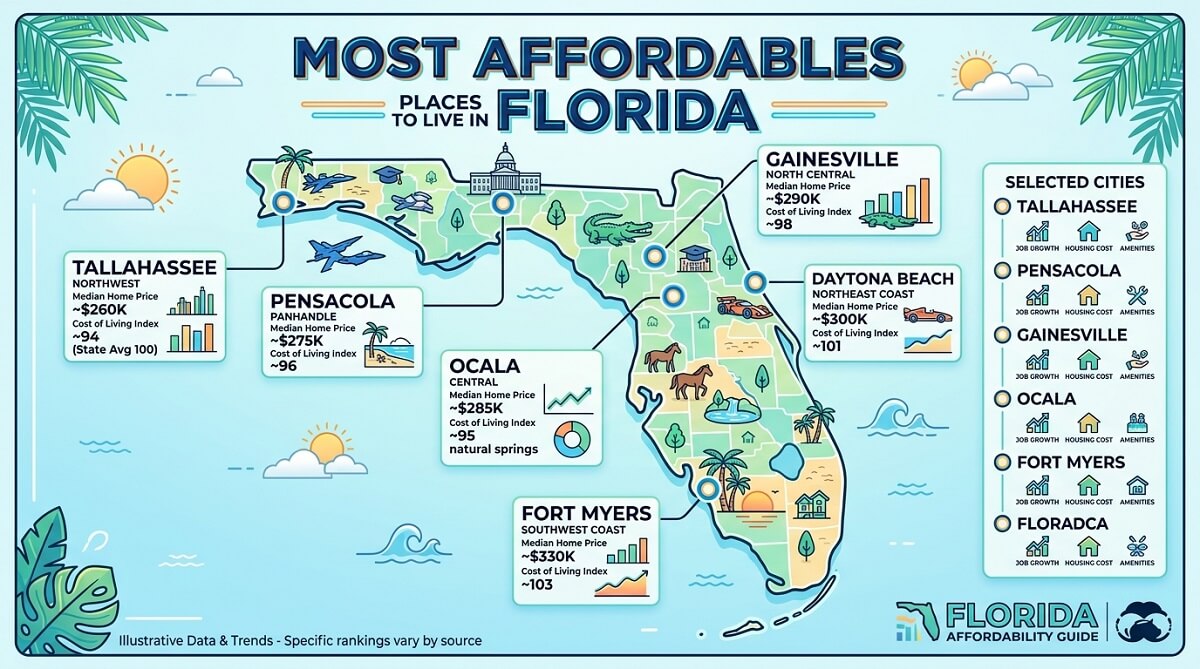
The Most Affordable Place to Live in Florida: A 2026 Reality Check
The era of cheap sun and easy equity has vanished. If you are hunting for the most affordable place to live in Florida as we move through February 2026, you have likely realized that listing prices tell only half the story. While the Federal Reserve’s pivot toward 6.2% rates has finally forced a 5.2-month inventory surplus, the “Sunshine Tax” remains stubbornly high.
Monthly carrying costs now hinge on insurance premiums that vary wildly by zip code. You aren’t just buying a house; you are subsidizing a risk pool. Finding the cheapest place to live in Florida requires a cold-eyed look at inland stability versus coastal volatility.
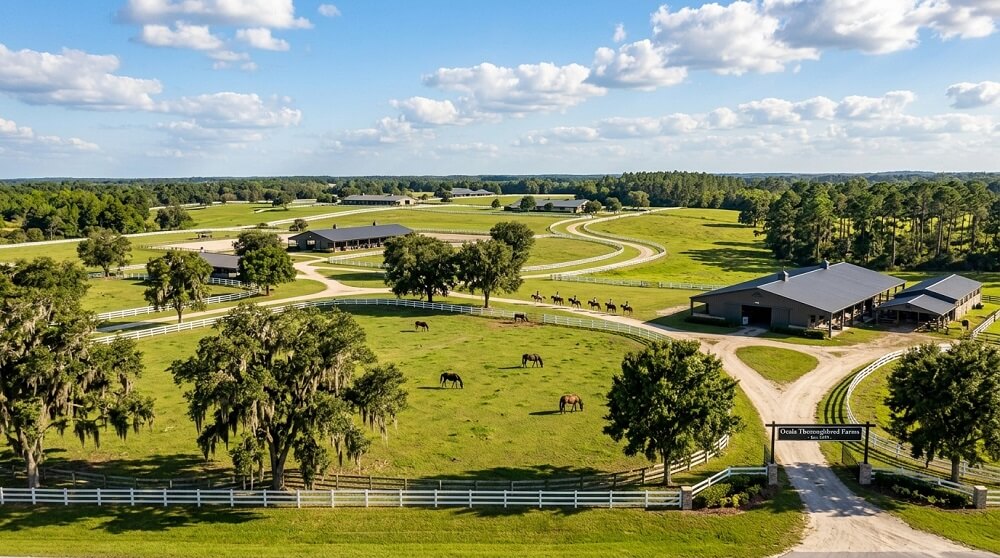
1. Ocala: The High-Ground Value Leader
Ocala remains the primary target for those who prioritize mathematical certainty over a beach breeze. With a median price point of $279,900, it persists as a rare pocket where new builds stay under the $300k threshold.
Advantages: Insurance and Infrastructure
Sitting on a limestone plateau, Ocala is geographically shielded from storm surges. This keeps premiums among the lowest in the state. One might argue it is the only “hurricane-proof” major metro in the region. The World Equestrian Center has also spiked the local economy, planting high-end dining in a city where the median home price remains modest. You are positioned an hour from Orlando, avoiding the soul-crushing gridlock of I-4.
Disadvantages: Climate and Career
The humidity here is punishing. Without a sea breeze to stir the air, July afternoons feel like a physical weight. Furthermore, the economy lacks breadth. While logistics and healthcare provide steady paychecks, the job market remains stubbornly tied to horses and hauling. If your career falls outside these silos, the professional landscape feels thin. It is a town built for specialized labor, not for those seeking an expansive corporate ladder.

2. Jacksonville: The Urban Workhorse
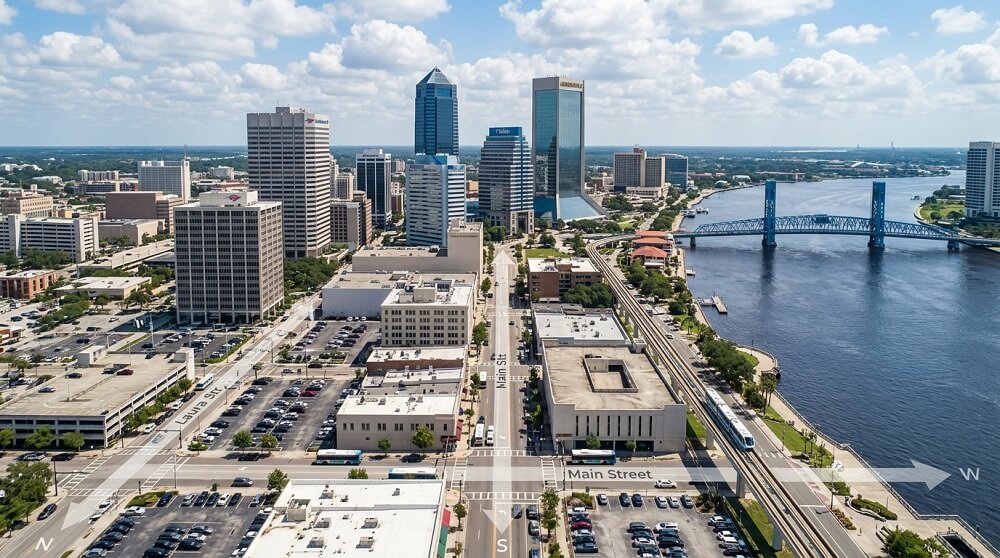
Jacksonville is a massive, industrial-strength contradiction. While it is often cited as a budget haven, the value is concentrated in specific sectors like the 32208 zip code and Northside.
Advantages: Jobs and Water
Jacksonville offers the most functional job market on this list. With a 3.5% unemployment rate and a deep banking sector, it serves as a place to build a career. It remains the only major metro where you can secure “big city” amenities and coastal proximity at a $305,000 price point. The 22 miles of beaches and the St. Johns River provide an outdoor lifestyle that generally costs double in South Florida.
Disadvantages: Sprawl and Safety
Size is Jacksonville’s greatest liability. It is the largest city by landmass in the contiguous U.S., making a car an expensive necessity. Public transit is an afterthought. Commutes of 45 minutes are the baseline. Additionally, the data remains recalcitrant regarding crime in specific urban sectors. One must be extremely diligent; a “good” block can sit adjacent to a high-crime corridor. This geographic fragmentation makes neighborhood-level research a non-negotiable requirement.
3. Pensacola: Panhandle Economics
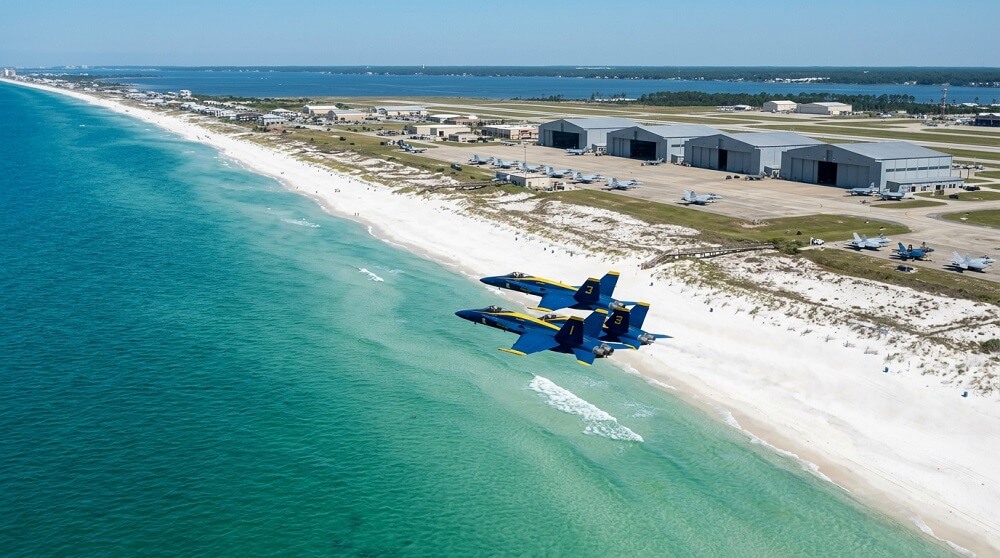
Pensacola offers a unique blend of Caribbean-grade aesthetics and military-stabilized economics. The $330,000 median reflects a market that has cooled but remains highly liquid.
Advantages: Aesthetics and Investment
The sand here is whiter than anything in the Caribbean. It offers a luxury aesthetic for a middle-market cost. The presence of NAS Pensacola also provides a recession-proof floor for the local economy. For investors, this military footprint ensures the rental market stays tight. It is a pragmatic choice for those who value the Gulf but lack the budget for the multimillion-dollar prices of 30A.
Disadvantages: Risk and Crowds
The Panhandle is a lightning rod for tropical systems. While 2025 was quiet, historical data suggests a higher risk of direct hits, which keeps insurance premiums noticeably higher than in Ocala. Summer is equally volatile. Tourism is the city’s lifeblood, but it turns local transit into a parking lot from June to August. During these months, the simple act of crossing the bridge to the beach becomes a tactical exercise in frustration. You are buying beauty, but you are also buying the crowds.
4. Gainesville: The Med-Tech Hedge
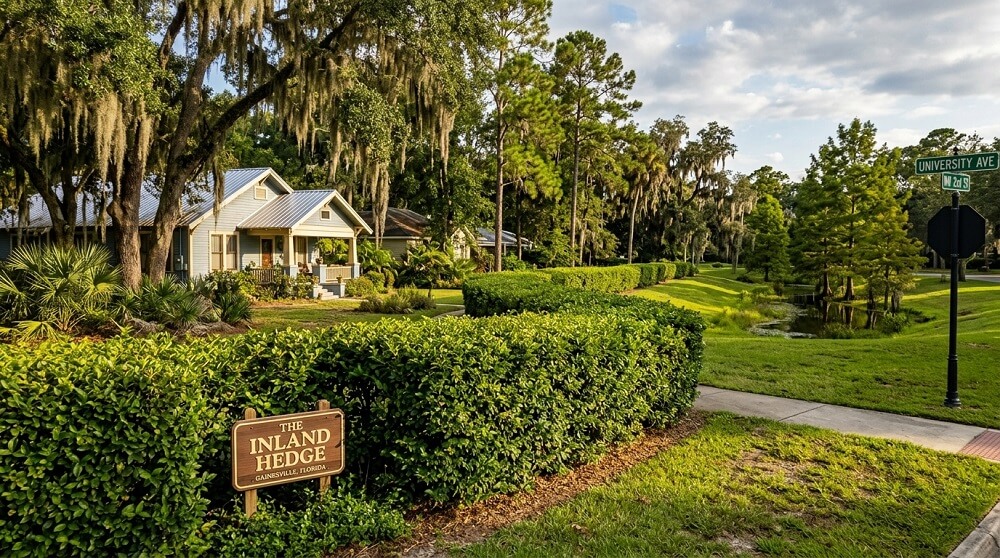
Gainesville is often dismissed as a mere university town, yet its medical infrastructure makes it a 2026 standout for long-term stability.
Advantages: Intellect and Taxes
Gainesville’s value is found in its brainpower. Home to the University of Florida, the city provides medical and cultural amenities that far outstrip its size. In 2026, the indexed Homestead Exemption makes Gainesville’s property tax rates some of the most stable in the state. It is a town for those who prefer woods and springs over salt and sand. The medical infrastructure alone makes it a superior choice for those aging into more frequent healthcare needs.
Disadvantages: The Student Grip
The university is the sun, and the rest of the city merely orbits it. When school is in session, the population density spikes to irritating levels. When school is out, the local economy can feel strangely hollow. This creates a bubble that may feel claustrophobic for those not affiliated with the institution. Furthermore, the 90-minute drive to Flagler Beach becomes a chore if you crave the coast. It is an intellectual enclave, but it is also an isolated one.
5. Sebring: The Absolute Floor
If your search for the most affordable place to live in Florida is strictly about the bottom line, Sebring is the end of the road.
Advantages: Entry Price and Nature
In certain sectors, median values sit at $260,000. It is perhaps the last place in the state where a single earner can qualify for a home without a co-signer. Large swaths of the area are eligible for USDA zero-down loans, a massive lever for those with limited liquid capital. The 100+ lakes in Highlands County offer a “Slow Florida” pace that is increasingly rare. It is a low-cost lifestyle for those who find serenity in freshwater fishing and quiet nights.
Disadvantages: Fragility and Stagnation
The low price reflects a fragile economy. Jobs are scarce and wages are stagnant. Most residents either bring a remote paycheck or endure a brutal commute to larger hubs. Culturally, the city is aggressively quiet. Nightlife is non-existent. For a retiree, this is a feature; for anyone under 40, it is a bug. One might argue that the money you save on a mortgage is simply paid back in lost career growth and social isolation.

The 2026 Cost Breakdown
| Location | Median Price (Feb 2026) | Est. Monthly Carry | Market Vibe |
| Ocala | $279,900 | $1,800 | Inland/Medical |
| Lake City | $215,000 | $1,540 | Rural/Quiet |
| Jacksonville | $305,000 | $1,980 | Metro/Growth |
| Pensacola | $330,000 | $2,120 | Coastal/Military |
| Sebring | $260,000 | $1,650 | Central/Retiree |
Hard Truths from the Field
One might argue that the “inland discount” is the only way to survive the current insurance climate. Moving 30 miles from the coast, into towns like Inverness, can slash your premiums by 40% overnight. It is a trade-off between a sea breeze and a solvent bank account.
The data also shows a strange divergence between new construction and resale. In Cape Coral, builders are so desperate to clear inventory that they are buying down rates to the 5% range. Sometimes, the “cheaper” older home is actually more expensive when you factor in the financing and the aging roof.
Final Assessment
Lake City and Sebring win on pure price, but they lack the economic ceiling of larger hubs. If you need a career to match your mortgage, Jacksonville provides the best balance of entry price and future appreciation. Florida isn’t “cheap” anymore, but it is finally becoming predictable again.