
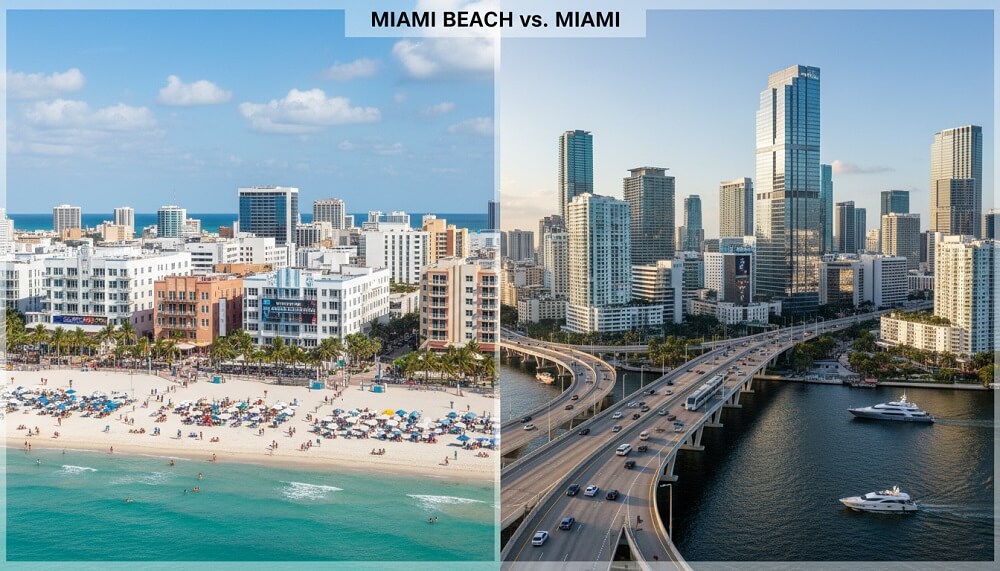
The 2026 Reality Check: Is Miami Beach Better Than Miami?
Deciding whether is Miami Beach better than Miami depends entirely on your tolerance for logistical friction versus your desire for a specific brand of Atlantic aesthetics. By February 2026, the distinction between these two municipalities has sharpened. We are no longer looking at a simple “beach vs. city” binary. Instead, travelers and prospective residents must navigate a landscape defined by aggressive special-event pricing and a mainland that has finally matured into a global financial heavyweight.
The Core Difference: Mainland Hustle vs. Island Vibe
One might argue that the geographic gap across Biscayne Bay has never felt wider. The mainland has shed its image as a mere gateway to the sand, evolving into a dense, vertical urbanity.
Miami (The City): Art, Finance, and Latin Soul
The mainland, specifically the Brickell-to-Edgewater corridor, mirrors the frantic energy of Hong Kong or Manhattan. It is a world of glass towers and air-conditioned sky-bridges. While the “Wall Street of the South” label feels like a marketing reach, the presence of high-frequency trading firms and a legitimized tech scene suggests a permanent shift in the city’s DNA.
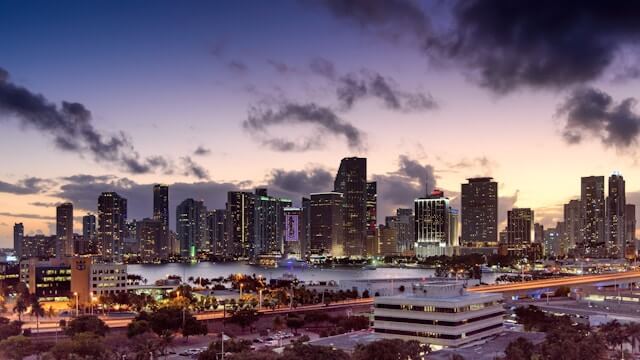
Miami Beach (The Island): Art Deco, Neon, and Ocean Breeze
The Beach remains an intentional throwback. It is a low-rise, human-scale environment defined by its 1930s architecture and the unrelenting humidity of the Gulf Stream. It is curated. It is also increasingly restrictive, as the local government attempts to “reclaim” the streets from the very tourism that fuels its tax base.
2026 Cost Comparison: Your Wallet’s Perspective
The data regarding South Florida’s affordability remains recalcitrant. While inflation elsewhere has cooled, the “Sun Tax” persists here with a particular vengeance.
| Expense Category | Miami (Mainland) | Miami Beach |
| Hotel Night (2026) | $240 – $280 | $310 – $450 |
| Monthly Rent (1BR) | ~$2,800 | ~$3,500 |
| Standard Cocktail | $18 – $22 | $24 – $30 |
| Daily Parking | $25 | Up to $100 |
One must account for the “Dynamic Parking” trap. On weekends, the city of Miami Beach often hikes garage rates to triple digits. It is a blunt instrument designed to discourage anyone who doesn’t live within the zip code.
The FIFA World Cup 26™ Effect: Infrastructure & Crowd Warnings
The upcoming tournament has skewed every historical metric of “better.” If you are here for the matches, staying on the island is a tactical error.
Hard Rock Stadium sits far to the north on the mainland. The commute from South Beach during a match week will likely exceed two hours. Conversely, the FIFA Fan Festival at Bayfront Park makes Downtown Miami the logical, if crowded, center of gravity. We are seeing a massive infrastructure strain that the current public transit system—even with the 2026 Brightline expansions—is barely equipped to handle.
Logistics & The “Car Trap”
The choice between the two often comes down to your relationship with a steering wheel. On the Beach, a car is a liability. The free trolley system and high density make it one of the few places in Florida where “walkability” isn’t a myth.
The mainland is different. Despite the rise of micro-mobility, Miami remains a city of highways. If you intend to visit the Wynwood galleries or the historic groves of Coconut Grove, you will need a vehicle. You will also need patience for the I-95 corridor, a stretch of asphalt that defies every law of civilized transit.
The 2026 “Experience Gap”: What the Brochures Hide
The Service Charge Scandal
Transparency is a rare commodity on Ocean Drive. It is now standard practice for venues to stack a 20% service fee, a 7% tax, and a 2% climate surcharge. This creates a nearly 30% premium before you even consider an additional tip. Check your receipt. Most tourists pay twice because they fail to read the fine print.
The Spring Break Break-up
The city of Miami Beach has essentially declared war on its own reputation. The 2026 regulations include license-plate readers and strict bans on outdoor music. This creates a sterilized environment. While safer, some argue it has stripped the Beach of the chaotic energy that made it famous in the first place.
The Verdict: Who Should Choose Which?
Select the Mainland if you value proximity to the World Cup festivities, a modern urban aesthetic, and a slightly more diverse culinary scene. It is the choice for the pragmatist.
Select Miami Beach if you require the ocean as a backdrop and don’t mind the “tourist tax” that permeates every transaction. It is for those who value the view over the value proposition.
Local Insider Tips: How to “Miami” Like a Pro
- Avoid Ocean Drive Dining: The food is mediocre. The prices are predatory. Move west to Alton Road for something edible.
- Use the Water Taxi: For $20, you can bypass the causeway traffic. It is the only efficient way to cross the bay during peak hours.
- The 4 PM Rule: Storms here are predictable. The sky will open up late in the afternoon. Secure your beach spot by 9 AM and be indoors by 3:30 PM to avoid the deluge.
Investment Analysis: Miami vs. Miami Beach
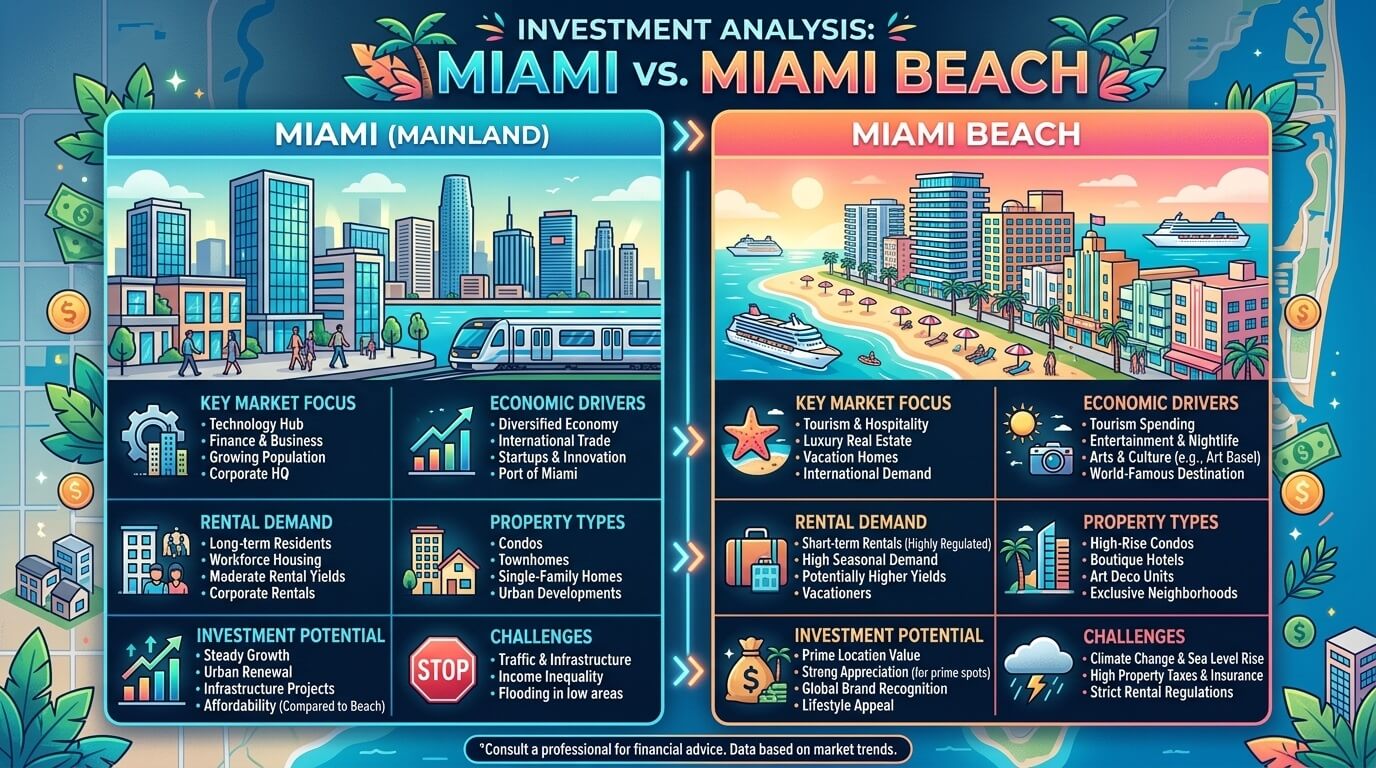
Investment analysis in South Florida often begins with a simplified debate: mainland efficiency versus beachfront prestige. That framing misses the real issue. Miami and Miami Beach operate under separate economic logics, and capital responds accordingly. The question is not which market looks stronger today, but which structure absorbs pressure better over time. Investors who ignore that distinction tend to confuse lifestyle appeal with investment durability.
Market Fundamentals
At surface level, Miami and Miami Beach appear linked. Shared branding, shared tourism flows, shared international attention. Yet the demand drivers diverge once transactions close. Miami behaves like a working city. Employment growth, corporate relocations, and domestic migration sustain housing demand across cycles. Miami Beach depends more heavily on discretionary ownership — second homes, wealth storage, seasonal residency. This suggests a trend toward steadier absorption on the mainland during economic stress, although the data remains somewhat recalcitrant regarding short-term luxury resilience. A beachfront address carries status; status alone does not guarantee liquidity.
Price Entry & Capital Requirements
| Metric | Miami | Miami Beach |
|---|---|---|
| Entry Price Range | Wider | Higher baseline |
| Condo Dominance | High | Extremely high |
| Single-Family Availability | Moderate | Very limited |
| Investor Accessibility | Easier | Capital intensive |
Rental Demand Dynamics
Miami: Employment-Driven Rentals
Rental demand in Miami originates from workforce expansion. Finance, logistics, healthcare, and technology sectors create continuous tenant inflow. Leases skew long-term. Stability emerges not from speculation but from necessity — tenants live near employment centers because commuting alternatives remain imperfect. Income streams therefore track population growth more than seasonal tourism cycles.
Miami Beach: Lifestyle Rentals
Miami Beach rental performance follows a different rhythm. Demand often peaks with seasonal migration and luxury travel patterns. Some properties achieve strong short-term income during high-demand periods, though regulatory constraints and building policies limit operational freedom. Consistency becomes the central question. The assumption that ocean proximity guarantees superior rental yield deserves skepticism; operating expenses frequently erode headline revenue figures.
Operating Costs & Carrying Risk
| Expense Category | Miami | Miami Beach |
|---|---|---|
| HOA Fees | Variable | Often elevated |
| Insurance | High | Higher coastal exposure |
| Maintenance Reserves | Increasing | Strict inspection funding |
| Parking Costs | Moderate | Premium pricing |
Appreciation Patterns
Miami appreciation tends to follow demographic expansion and neighborhood evolution. As new employment clusters form, adjacent housing markets adjust upward. Miami Beach appreciation leans on land scarcity and global capital inflows. Values may accelerate quickly when international demand strengthens, yet transaction volume can slow when external conditions shift. This suggests differing volatility profiles rather than a simple performance hierarchy. Mainland growth often looks incremental. Island pricing can move in sharper steps.
Liquidity & Exit Strategy
Liquidity determines whether gains remain theoretical or realized. Miami properties attract varied buyer pools: residents, domestic investors, institutional buyers, relocation households. Multiple exit paths reduce dependence on any single demand group. Miami Beach exits rely more heavily on affluent lifestyle buyers. When sentiment among that cohort softens, transaction timelines extend. Investors rarely plan for slower exits, though market history repeatedly shows they should.
Investor Profiles — Best Fit
Miami Works Best For:
- Buy-and-hold investors
- Long-term rental strategies
- Appreciation tied to urban growth
- Portfolio diversification goals
Miami Beach Works Best For:
- Cash-dominant buyers
- Lifestyle-oriented ownership
- Trophy asset accumulation
- Hybrid personal-use investments
These categories reflect usage patterns rather than rigid rules. Investors occasionally succeed by moving against consensus, though such strategies require tolerance for uncertainty.
Risk Considerations
All South Florida assets share structural exposure: insurance volatility, climate risk, regulatory change, interest-rate sensitivity. Miami distributes risk across economic sectors and geographic scale. Miami Beach concentrates exposure within a smaller physical footprint and a narrower demand base. Concentration can amplify returns during expansion phases. It can also magnify correction cycles — an uncomfortable truth often minimized in promotional narratives.
Strategic Verdict
From an investment analysis standpoint, Miami generally presents broader flexibility and steadier operational logic. Miami Beach offers scarcity-driven ownership with higher recurring costs and tighter margin tolerance. A cautious investor may treat Miami Beach as a long-term store of lifestyle value, while viewing Miami as an income-oriented urban asset. The distinction feels subtle at acquisition. Over ten years, it tends to define performance.


Join The Discussion