
What is the Cost of Living in Miami, FL?
A Skeptical Resident’s Guide
Calculating what is the cost of living in Miami, FL requires more than a glance at a spreadsheet. It demands a look at a city currently rewriting its financial DNA. Miami has transitioned from a playground for the wealthy into a permanent, high-stakes hub for global finance. This shift has pushed local expenses roughly 21% above the national median. If you expect a discount because of the palm trees, the latest data suggests you should recalibrate those expectations immediately. While the lack of state income tax remains a powerful draw, it often functions as a secondary factor to the primary, often volatile, expense of simply staying housed.
The “Magic City” Price Tag: An Overview
Miami’s reputation for glamour often masks a grinding fiscal reality for those not earning in the top bracket. One might argue that the city’s economic profile now mirrors Los Angeles more than its Southern neighbors. The current climate is defined by high demand and limited land. This creates a specific kind of pressure on daily life that transcends simple inflation. We see this most clearly in the way “lifestyle” costs—those non-negotiable social expenses—have crept upward.
Housing & Real Estate: The Biggest Budget Driver
Shelter remains the dominant variable in any South Florida budget. The market is currently experiencing a peculiar stagnation. While inventory has surged by nearly 78%, prices refuse to collapse. They are merely settling. This creates a landscape where leverage exists, but only for those with significant liquidity.
Rental Market Trends by Neighborhood
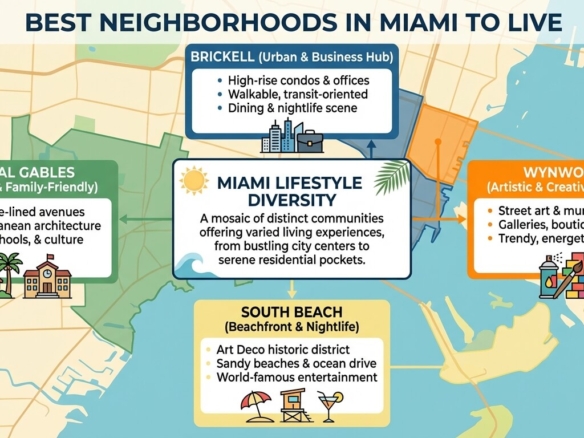
Renters face a fragmented market. In the high-rise corridors of Brickell, a one-bedroom apartment frequently commands $3,500. This reflects the area’s density and proximity to the financial district. Step into Little Havana or Coconut Grove, and the numbers soften to a range between $1,800 and $2,500. However, these “lower” prices often come with the trade-off of older infrastructure and less efficient cooling systems.
Buying in Miami: Market Shift to Buyer Leverage
The median home price of $565,000 tells only half the story. The real friction lies in “Days on Market,” which now exceeds 80 days. Sellers are finally blinking. They are offering concessions that were unthinkable two years ago. Yet, a lower purchase price is often offset by the grim reality of homeowners insurance. In Miami, insurance isn’t a minor line item; it is a significant, mandatory expense that reflects the increasing frequency of extreme weather events.
The Hidden Cost of Paradise: Utilities & Maintenance
Monthly bills in Miami are dictated by the sun. Cooling a home here is a year-round necessity, not a seasonal luxury. This creates a permanent “energy tax” that many newcomers fail to model correctly.
Electricity & The “AC Tax”
Florida Power & Light bills average $157, but that figure is a baseline for small footprints. Larger homes often see bills exceeding $250 during the peak heat of August and September. It is a relentless expense. If your insulation is subpar, you are essentially subsidizing the outdoors.
Water, Sewer, and Trash Increases
The Miami-Dade Water and Sewer Department has moved toward more aggressive billing structures. A standard residential bill for 5,000 gallons now reaches approximately $105. These incremental hikes, while small individually, suggest a long-term trend of rising municipal costs to fund aging infrastructure.
Getting Around: Transportation & Car Culture
Miami remains stubbornly tied to the internal combustion engine. Public transit exists, but it lacks the reach needed for a truly car-free life. Residents often spend 20% of their take-home pay just to move from point A to point B. Between fuel and insurance premiums that frequently hit $5,000 annually, the cost of mobility is a significant drain on wealth. One could argue the city’s design actively penalizes those without a private vehicle. The Metromover and Trolley systems offer some respite in the urban core, but they are localized solutions to a county-wide problem.
Groceries & Dining: From Cafecito to Fine Dining
Food costs in Miami reflect a supply chain that ends at a peninsula. Grocery prices sit roughly 9% higher than the national average. A family of four should plan for a monthly outlay of $1,300 to $1,500. While discount markets like Sedano’s provide some relief, the high-end dining scene in Wynwood or the Design District is purely discretionary and increasingly expensive. A standard dinner for two easily surpasses $100.
The Florida Tax Advantage (And What It Doesn’t Cover)
The 0% state income tax is the city’s strongest recruitment tool. For high-earners, this can increase effective income by nearly 10%. However, the state makes up this revenue elsewhere. Property taxes average around 1.7% to 2%, and sales tax is a constant. The Homestead Exemption is a necessary shield for primary residents, capping assessment increases and providing a much-needed ceiling on annual tax climbs.
Insider Tips: How to Live in Miami Without Breaking the Bank
Living well here requires local knowledge. Avoid the tourist traps of South Beach for your daily needs. Small shifts, like setting your thermostat to 78°F or utilizing the Freebee shuttle, can save hundreds over a year. The most successful residents treat Miami like a small town with big-city prices—they find the pockets of value that the glossy brochures ignore.
Monthly Budget Breakdown: Three Real-World Personas
| Expense Category | The Digital Nomad (Studio) | The Urban Professional (1BR) | Family of Four (3BR House) |
| Housing | $2,100 | $3,100 | $5,000 |
| Utilities/Web | $180 | $250 | $450 |
| Food/Dining | $700 | $1,000 | $1,800 |
| Transportation | $150 | $600 | $1,100 |
| Health/Misc | $300 | $500 | $1,200 |
| Total Monthly | $3,430 | $5,450 | $9,550 |
Frequently Asked Questions
Is it actually possible to live in Miami on a “normal” salary?
One might argue that “normal” is a relative term in a city where the median household income sits near $78,152, yet a comfortable lifestyle often requires six figures. If you are earning the median, you aren’t priced out, but you are forced into a specific kind of tactical living. This usually involves residing in “frontier” neighborhoods like Flagami or West Miami and strictly limiting discretionary spending in high-cost hubs like Brickell.
Why is car insurance in Miami so much higher than in other cities?
The data remains somewhat recalcitrant, but the consensus among local experts points to a trifecta of high litigation rates, frequent luxury vehicle accidents, and the persistent risk of flood damage. Expect to pay roughly 15% more than the national average. It is a non-negotiable “entry fee” for the convenience of South Florida’s highway system.
Do I really need to speak Spanish to survive financially in Miami?
While not a literal requirement for survival, lacking Spanish can be an “invisible tax” on your time and wallet. In many service-heavy industries and local trade sectors (like construction or specialized repair), Spanish is the default. Being able to navigate local markets and negotiate with contractors in their native tongue often leads to better “local” pricing that isn’t available to the uninitiated.
Is the “Buyer’s Market” in real estate a permanent shift?
This suggests a trend, though likely a temporary one. With inventory growing by 11.2% recently and homes sitting on the market for an average of 93 days, buyers have rare leverage. However, Miami’s land is finite. The current cooling is more of a market “settling” after years of unsustainable fever rather than a long-term decline in value.
What is the most overlooked “hidden cost” for new residents?
Beyond the obvious utility spikes, it is the HOA and Special Assessments. Many newcomers buy into older condo buildings lured by lower prices, only to be hit with five-figure assessments for structural repairs or modernizing fire systems. In the wake of new state safety regulations, these “surprises” have become a regular friction point in Miami real estate.

Join The Discussion