


The Analytical Reality: Pros and Cons of Living in Florida
Moving to the Sunshine State used to be a binary choice between a golf course and a beach. Today, that calculus has shifted. The pros and cons of living in Florida now hinge on a complex web of insurance math, shifting migration patterns, and a climate that demands constant vigilance. While the tax benefits remain a primary draw, the actual “cost of entry” has spiked in ways that the glossy brochures rarely acknowledge. One might argue that the state is currently undergoing a structural rebalancing that favors the cautious over the impulsive. The data remains somewhat recalcitrant regarding long-term affordability, suggesting a trend where the “Sunshine Tax” is becoming a permanent fixture of the state’s balance sheet. Some experts point to the recent inventory surge as a sign of health, yet this ignores the underlying reality that many sellers are merely fleeing rising carrying costs.
20 Pros of Living in Florida
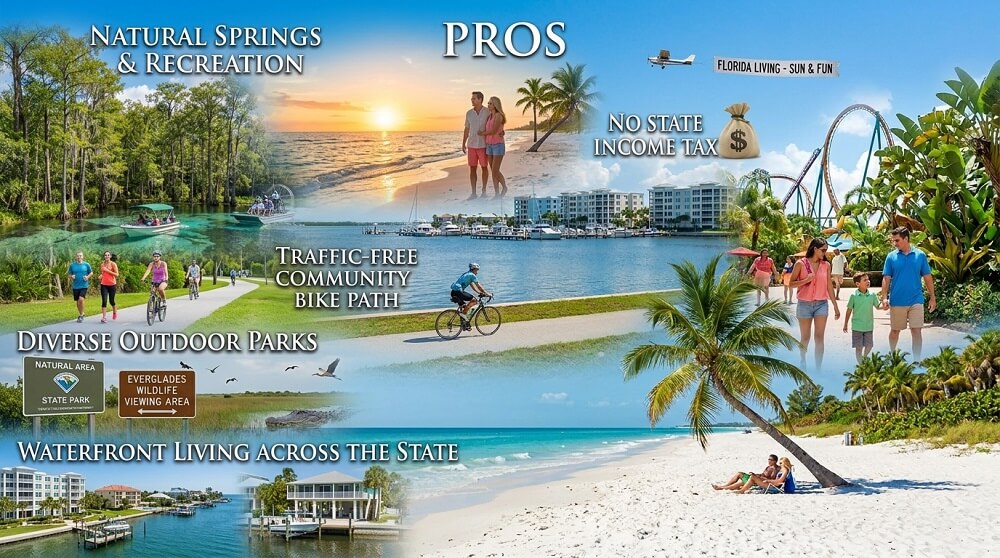
- Zero State Income Tax. The absence of a state income tax stands as the heaviest hitter on the financial ledger. This policy puts a significant chunk of change back into your pockets every pay cycle, particularly for those escaping high-bracket jurisdictions. It creates a specific kind of economic momentum that draws in capital from across the country.
- The Homestead Exemption Cap. Permanent residents benefit from the “Save Our Homes” amendment, which blocks annual property assessment hikes at 3% or the CPI. This provides vital long-term financial predictability for homeowners. It shields them from the rapid market appreciation seen in coastal areas.
- Rebalancing Real Estate Inventory. Florida’s housing market has shifted from a frenzy to a more balanced state in several key regions. Statewide inventory has increased significantly compared to previous years. This gives buyers more options and more negotiating power than they have had since the early 2020s.
- Booming Tech and Finance Hubs. The “Great Migration” brought more than just people; it brought industry giants. Cities like Miami and West Palm Beach have started to attract firms like Citadel and Goldman Sachs. This diversification means the economy is no longer solely dependent on tourism and agriculture.
- Resident-Only Attraction Discounts. Living here grants you access to deep discounts at some of the world’s most famous attractions. Residents often purchase annual passes to Disney World or Universal Studios at 30% off the tourist rate. Many state parks and high-end hotels offer “Florida Resident Rates” during the off-season.
- The Bright Futures Scholarship. Florida’s commitment to higher education is exemplified by this merit-based scholarship program. Depending on academic performance, the state may cover 75% to 100% of tuition at top-tier public universities. This program saves families tens of thousands of dollars in student debt.
- Year-Round Outdoor Recreation. The Florida lifestyle is defined by the outdoors. Whether it’s golfing in Naples or kayaking the springs of Ocala, you are never restricted by a “snow season.” This constant access to nature contributes to higher activity levels for those who enjoy heat.
- Strategic Global Connectivity. Florida serves as a primary gateway to the Americas and Europe. Major international airports in Miami and Orlando offer frequent, low-cost flights to almost every corner of the globe. For business travelers, this connectivity is unparalleled in the Southern United States.
- Diverse Cultural Melting Pot. The state’s demographic makeup is incredibly diverse. This manifests in a world-class culinary scene and vibrant arts districts like Wynwood. Living here feels like being at a global crossroads, providing exposure to different languages and traditions.
- Resilience in Master-Planned Communities. Florida leads the nation in “smart” towns like Babcock Ranch. These developments are built with storm-resilient infrastructure and sustainable water management systems. They offer a “plug-and-play” lifestyle designed to withstand unique environmental challenges.
- Abundant Freshwater Springs. Beyond the beaches, Florida is home to the world’s largest concentration of natural springs. These maintain a constant 72°F year-round. They provide a refreshing escape from the summer heat and remain a favorite “local secret” for weekend diving.
- Professional Sports Haven. For enthusiasts, Florida is a paradise. The state hosts multiple NFL, NBA, and NHL teams. Additionally, Florida is the home of “Grapefruit League” Spring Training, where baseball fans can watch teams in intimate settings.+1
- Retirement Social Infrastructure. Florida has perfected the “Active Adult” lifestyle. Communities like The Villages provide an entire social ecosystem with hundreds of clubs and golf courses. This infrastructure ensures that retirees remain socially engaged and physically active.
- Lower Gas Prices. Due to its proximity to Gulf Coast refineries, Florida often enjoys gasoline prices lower than the national average. While transportation is car-dependent, the lower cost at the pump helps offset the long commute times common in sprawling metros.
- Healthcare Excellence. Florida is becoming a destination for medical tourism. The state is home to prestigious institutions like the Mayo Clinic in Jacksonville. With a large aging population, the state has invested heavily in high-level medical infrastructure.
- Pro-Business Environment. Florida’s legal framework is famously pro-business. The state has low corporate taxes and minimal red tape for startups. This “open for business” attitude has created a resilient economy that often recovers from national downturns quickly.
- No Estate Tax. Florida does not impose an inheritance tax or an estate tax. This allows residents to pass on their full wealth to their heirs. For families looking to build generational wealth, this lack of an estate tax is a massive strategic advantage.
- Public University Value. Florida’s public university system consistently ranks among the best in the nation for “Value for Money.” Institutions like the University of Florida provide top-tier research opportunities at a fraction of the cost of out-of-state schools.
- Local Agriculture. As a major producer, Florida offers year-round access to fresh produce. From Indian River citrus to winter strawberries, residents can eat locally even in January. Local farmer’s markets are a staple of the Florida lifestyle.
- Architectural Variety. From Art Deco masterpieces to Spanish Colonial charm, Florida offers a surprisingly rich history. Residents can choose between ultra-modern high-rises or historic “Cracker-style” houses. This variety allows homeowners to find a property that matches their aesthetic soul.

20 Cons of Living in Florida
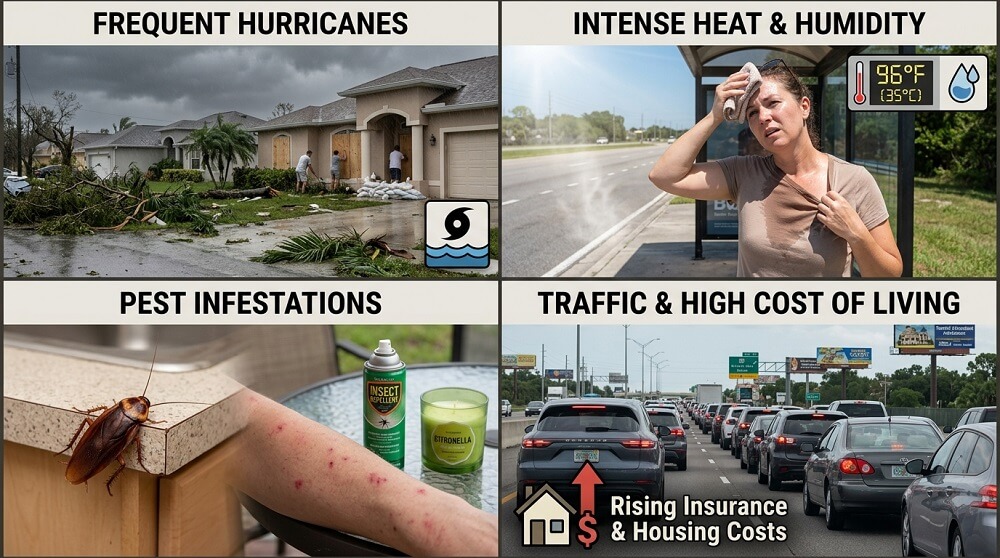
- The Insurance Crisis. Home insurance in Florida is still roughly 3x higher than the national average. The combination of hurricane risk and historical litigation issues has caused many private insurers to leave. Many find themselves pushed toward Citizens, the state’s insurer of last resort.+1
- Extreme Summer Humidity. The heat is manageable, but the humidity is a different beast. From June through September, the dew point often reaches levels that make it feel like you are walking through a sauna. This puts a massive strain on your HVAC system.
- Skyrocketing Auto Insurance. Often overlooked in the “pro-tax” argument is that Florida has some of the highest car insurance premiums in the U.S. High rates of uninsured drivers mean your tax savings can be eaten up by your monthly policy costs.
- Total Car Dependency. Outside of a few small pockets in Miami or St. Pete, Florida is almost entirely car-dependent. Public transportation is notoriously underfunded. The lack of walkability in most suburban communities means even a simple trip for milk requires a 15-minute drive.
- Hurricane Anxiety. Living here means living with the June-to-November hurricane season. Even if a major storm doesn’t hit your zip code, the prep—boarding windows and gas lines—creates a seasonal mental load. It is a recurring tax on your peace of mind.
- Infrastructure Gaps. Rapid population growth has outpaced road construction. In metros like Orlando and Miami, “rush hour” is a nearly all-day event. Longtime residents often complain that the “small-town feel” has been replaced by endless strip malls and clogged intersections.
- Tropical Pests. In Florida, the bugs are bigger. From “Palmetto bugs” to swarms of Lovebugs, pest control is a non-negotiable monthly expense. Termite protection is also a critical requirement for homeowners due to the moist climate.
- Rising Cost of Goods. Because Florida is a peninsula, most goods must be trucked in from the north. This leads to higher prices for groceries. Recent data shows that Florida’s inflation rate has occasionally spiked higher than the national average.
- Wildlife Risks. Florida’s ecosystem is thriving, which means alligators and snakes are part of daily life. This requires a level of environmental awareness—especially for those with pets—that can be unnerving for newcomers. Never walk your dog near a freshwater pond at dusk.
- Political Polarization. Florida has shifted from a “purple” swing state to a deeply partisan environment. Depending on your personal views, the highly charged political climate can feel like a significant cultural con. Local governance is often caught in the crosshairs of national debates.
- Sinkhole Vulnerability. Portions of Central Florida sit on a limestone bed susceptible to collapse. While “catastrophic ground cover collapse” is usually included in insurance, “sinkhole coverage” is an expensive add-on. A sinkhole claim can make a home virtually unsellable.
- Red Tide Blooms. Florida’s coastline occasionally suffers from “Red Tide.” These algal blooms can kill fish and release toxins into the air that cause respiratory issues. For coastal residents, it can ruin months of beach access and devastate local waterfront businesses.
- K-12 Education Rankings. While Florida’s universities are excellent, its K-12 public schools often rank in the bottom half of the country for funding. Many families feel compelled to pay for private schooling. This creates an additional financial burden for parents.
- Tourist Overload. From January to April, the population swells as “Snowbirds” arrive. This leads to a total saturation of local infrastructure. Expect 45-minute waits at your favorite local restaurants and significantly higher surge pricing for services.
- Radon Gas Issues. Many newcomers are unaware that Florida has significant issues with Radon. Because many homes are built on concrete slabs, the gas can become trapped in living spaces. Testing and installing mitigation systems is a common and necessary expense for homeowners.
- Lack of Seasons. If you enjoy the changing of the leaves, you won’t find it here. Florida has two seasons: “Hot and Wet” and “Warm and Dry.” The lack of seasonal transition can lead to a “time-warp” feeling where months blend together.
- Income Inequality. Florida has one of the widest wealth gaps in the United States. While billionaires flock to Palm Beach, the service workers often struggle to find affordable housing. This creates a “dual economy” that drives up service prices.
- Over-Development. The “Old Florida” of orange groves is rapidly disappearing. In its place are endless subdivisions. This “paving over” of the state has led to increased flooding issues, as there is less natural ground to absorb rainwater.
- Fraud and Scams. Florida consistently ranks as a top state for identity theft and financial fraud. From “contractor scams” after a storm to real estate wire fraud, residents must be constantly on guard. The state’s debtor-friendly laws occasionally attract bad actors.
- Transient Social Nature. Because so many people move to Florida and leave after a few years, building deep community roots is difficult. Your neighbors may change every 24 months. This transient culture can make it harder to find a tight-knit, multi-generational support system.
The math of moving to Florida remains attractive, yet one must account for the “hidden” frictions. The state is no longer the bargain it once was, requiring a more nuanced financial plan than in years past.
| Metric | Florida (2026 Baseline) | National Average | Strategic Impact |
| State Income Tax | 0% | ~4.8% (Avg) | High-earners effectively gain a 5–13% salary bump. |
| Homeowners Insurance | $7,136 (Avg) | $2,543 | 181% premium; the state’s largest financial friction. |
| Median Home Price | $370,112 | $357,445 | Prices are roughly 3.5% above the U.S. baseline. |
| Auto Insurance | $2,353 | $1,780 | ~32% higher due to high litigation and weather claims. |
| Cost of Living Index | 101.4 | 100.0 | Florida sits 1.4% above the national cost baseline. |
| Days on Market | 83–86 Days | ~50 Days | Buyer’s Leverage: Sellers are more likely to offer concessions. |
| Job Growth Rate | 2.2% – 2.6% | ~1.9% | Florida’s economy continues to outpace the U.S. average. |